


Melk: It Does An Abbey Good.
Aren't abbeys supposed to be dark, gray places? Perhaps not, because a visit to Melk Abbey (Stift Melk) was an experience in all kinds of opulent gold. It was so over-the-top it was almost camp, but it certainly was beautiful. No wonder it was featured and selected as an of the 1,000 Places To Visit Before You Die.

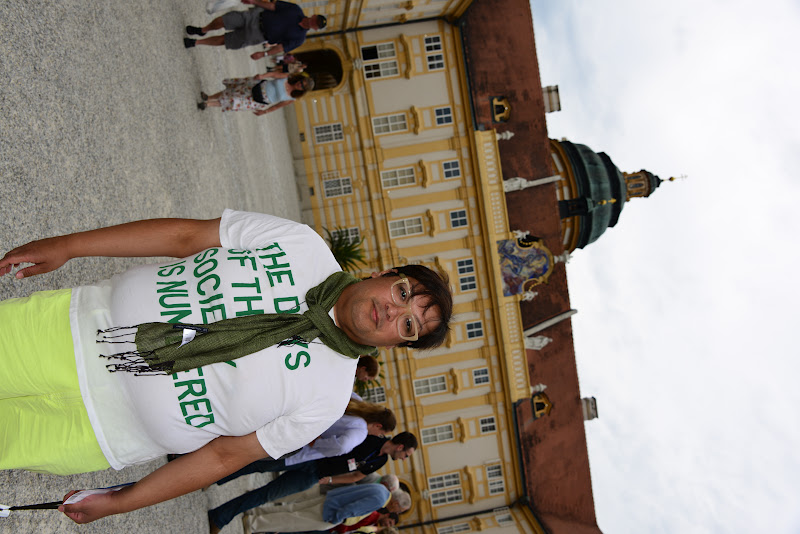


The abbey was founded in 1089 when Leopold II, Margrave of Austria gave one of his castles to Benedictine monks from Lambach Abbey. A monastic school, the Stiftsgymnasium Melk,
was founded in the 12th century, and the monastic library soon became
renowned for its extensive manuscript collection. The monastery's scriptorium was also a major site for the production of manuscripts. In the 15th century the abbey became the centre of the Melk Reform movement which reinvigorated the monastic life of Austria and Southern Germany.
Today's impressive Baroque abbey was built between 1702 and 1736 to designs by Jakob Prandtauer. Particularly noteworthy is the abbey church with frescos by Johann Michael Rottmayr and the impressive library with countless medieval manuscripts, including a famed collection of musical manuscripts and frescos by Paul Troger.
Due to its fame and academic stature, Melk managed to escape dissolution under Emperor Joseph II
when many other Austrian abbeys were seized and dissolved between 1780
and 1790. The abbey managed to survive other threats to its existence
during the Napoleonic Wars, and also in the period following the Nazi Anschluss that took control of Austria in 1938, when the school and a large part of the abbey were confiscated by the state.
The school was returned to the abbey after the Second World War and now caters for nearly 900 pupils of both sexes.


